
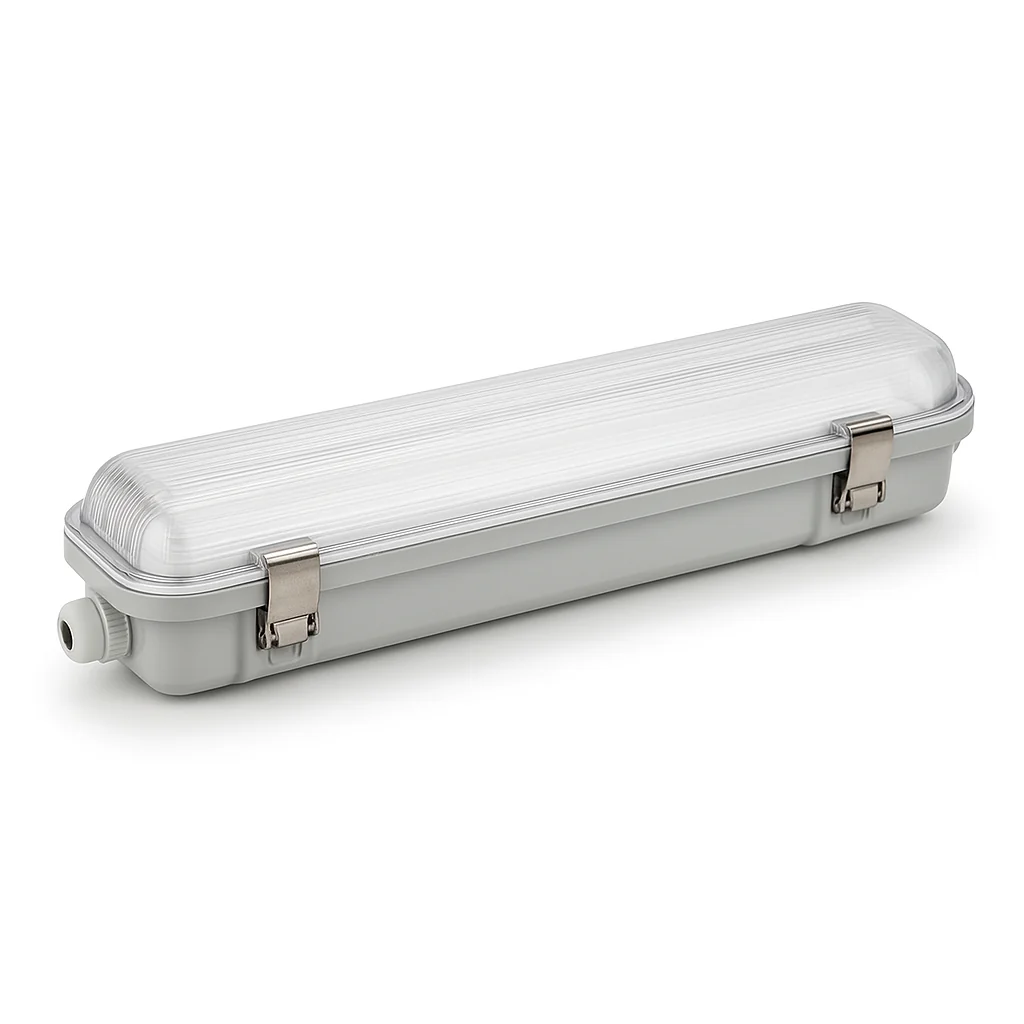
sensor Tri-Proof Lights
On a tri-proof light the sensor saves less energy than it saves you from lights that never get switched off: warehouse aisles and cold-store airlocks burn around the clock. A 3–5 minute hold is enough — longer and it might as well be permanently on, shorter and the light goes out while people are still walking.
Get a QuoteKey parameters
| Power | 20–40 W |
|---|---|
| Luminous flux | 2,600–5,200 lm |
| Mounting height | 2.5–4 m |
| IP rating | IP65 |
| Impact rating | IK08 |
| Hold time | 10 s – 10 min |
Which step the option actually changes
An option leaves the light output alone and touches three things: when it comes on, how long it stays on, and whether it stays on when the mains drop. Whether it earns its price is a question about the site — who operates the switch, and whether anyone has to walk out during an outage — not about the fixture.
The cost that gets left out is wiring: a sensor or emergency fixture needs a permanent live plus a switched line (or an emergency supply line), and retrofitting an old circuit means new conduit. If the quote excludes that, the site adds it later — often at close to the price of the fixtures.
When to add it and when not to
The case for adding it is specific: the fixtures sit at 2.5–4 m where nobody can reach them, the switch is inconvenient, or people have to find their way out during an outage. The case against is just as specific: 24-hour process lines, and sites that already run a central control system — a second layer of control only adds a failure point.
Emergency options carry one hard constraint: the duration and the emergency flux come from the fire code that applies at the site, not from the fixture wattage. Confirm the required duration and minimum illuminance first, then size the battery — reverse the order and you buy a fixture that has emergency output but does not meet the requirement.
Four things to verify before ordering
① Whether flux and efficacy are quoted for the complete fixture or the light source — a 10–15% difference that changes the fixture count. ② Whether colour temperature and CRI are measured or nominal values; mixed CCT within one batch is the most common arrival dispute. ③ Driver brand and model, plus its derating curve at high temperature — it is the only part that really sets life. ④ The mounting kit list: chain, bracket and anchors in the box, or the site stops for a day.
Concepts on this page
Need a Lighting Plan?
Tell us your scenario, Jie Zhai will help you choose.
Get a Quote All specification pages