
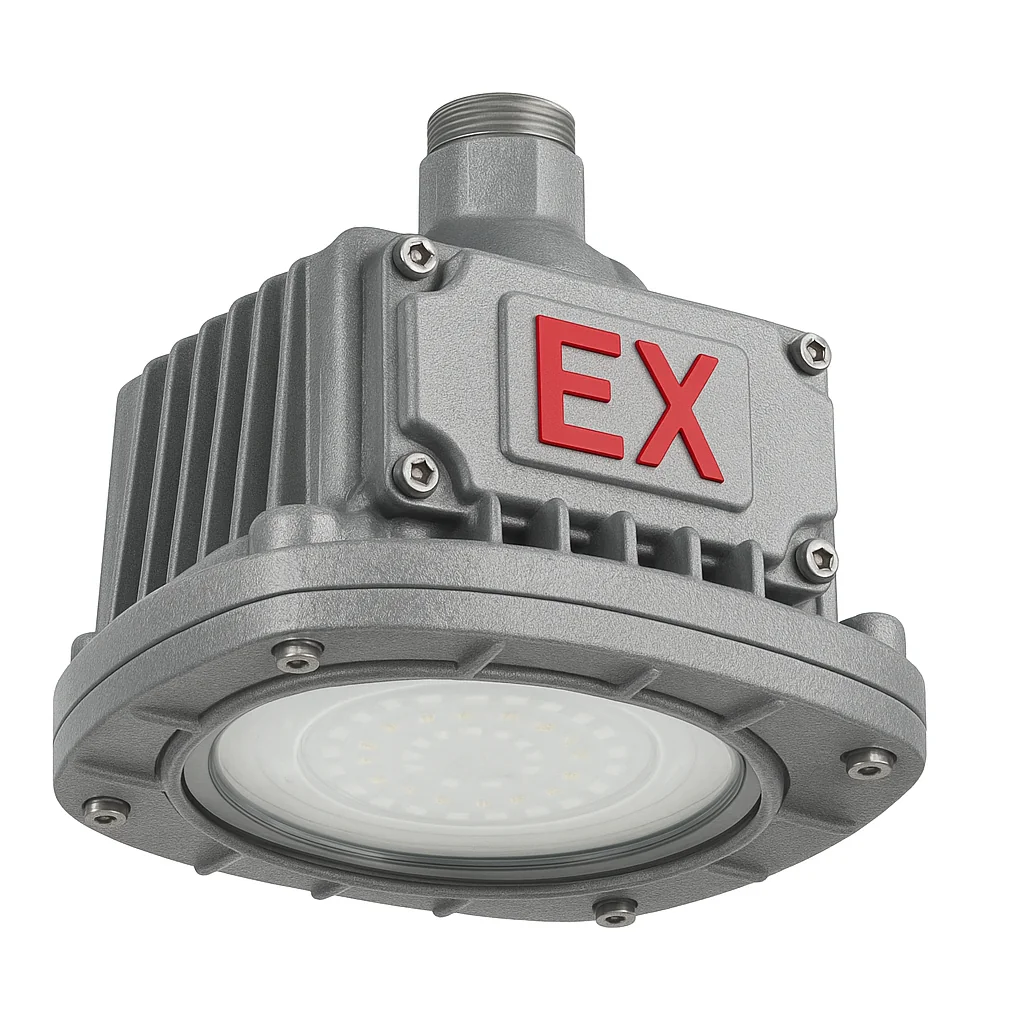
Zone 2 Explosion Proof Lights
Zone 2 is where an explosive atmosphere is unlikely in normal operation and, if it occurs, only briefly. The usual waste here is over-specifying: putting a Zone 1 flameproof fixture into Zone 2 costs nearly twice as much and is harder to maintain, because the flameproof face must not be knocked or painted. Confirm the zone from the hazardous-area drawing, then pick the concept.
Get a QuoteKey parameters
| Power | 30–150 W |
|---|---|
| Luminous flux | 3,500–19,500 lm |
| IP rating | IP66 |
| Impact rating | IK08 |
| Hazardous zone | Zone 2 |
| Protection concept | Flameproof / increased safety |
| Operating temperature | -20 … +40 ℃ |
Environment is not only about water
What actually kills fixtures on site, in order of how often it happens: ① heat — every 10 ℃ of chamber temperature roughly halves driver life; ② corrosive gas or salt fog — it eats the screws and the coating first and enters through the seam afterwards; ③ dust — it blocks the fins, which is heat again; ④ cold — capacitors struggle to start and plastics go brittle. IP covers only the water part.
So the order of questions should be: what is the ambient temperature, is there a corrosive medium, how is dust cleaned, what is the minimum temperature — and IP last. Reverse the order and the fixtures start failing three months in, with a perfectly adequate IP rating.
How to check the temperature item
This page is rated -20 … +40 ℃. Note that this is the ambient temperature the fixture tolerates, not the body temperature — the two differ by the temperature rise. What the driver sees is ambient plus rise, and the rise comes from heatsink area: same wattage, different construction, 20 ℃ apart.
The check is simple: ask for the driver model, then read its derating curve at the actual chamber temperature. A quote that cannot produce that curve has not answered the temperature question, whatever the ℃ figure says.
Four things to verify before ordering
① Whether flux and efficacy are quoted for the complete fixture or the light source — a 10–15% difference that changes the fixture count. ② Whether colour temperature and CRI are measured or nominal values; mixed CCT within one batch is the most common arrival dispute. ③ Driver brand and model, plus its derating curve at high temperature — it is the only part that really sets life. ④ The mounting kit list: chain, bracket and anchors in the box, or the site stops for a day.
Concepts on this page
Explosion-proof lightHazardous area zoneAmbient temperature rating
Need a Lighting Plan?
Tell us your scenario, Jie Zhai will help you choose.
Get a Quote All specification pages